Technical Documents
Specifications
Brand
FlukeProduct Type
Earth Tester Kit
Measurement Type
Earth Resistance
Includes
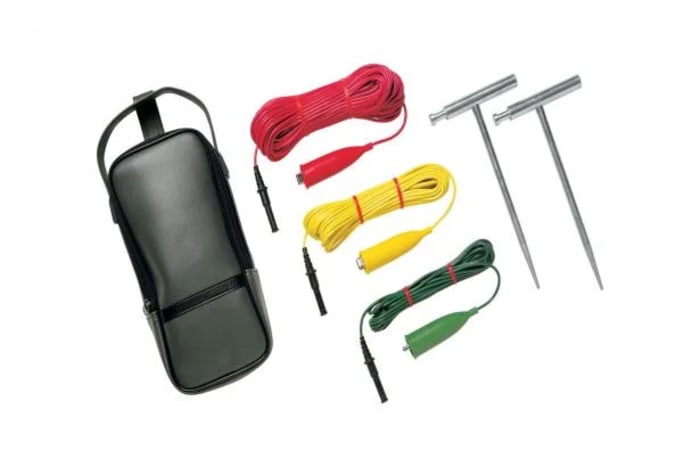
Carrying Case, Probe, Test Lead
Standards/Approvals
No
Model Number
ES165X
Country of Origin
Thailand
Product Details
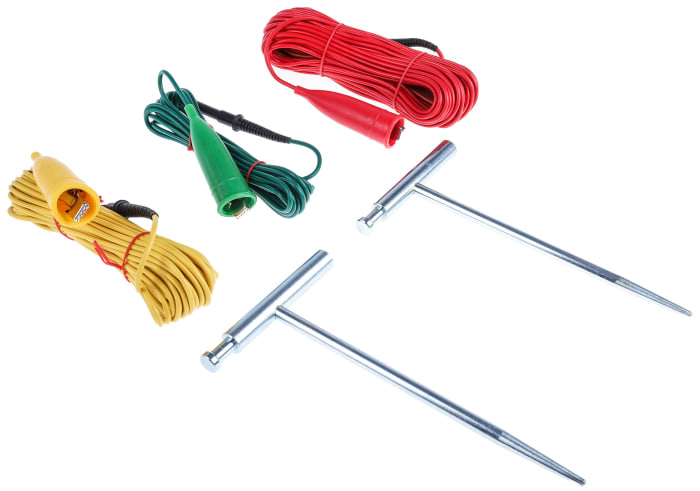
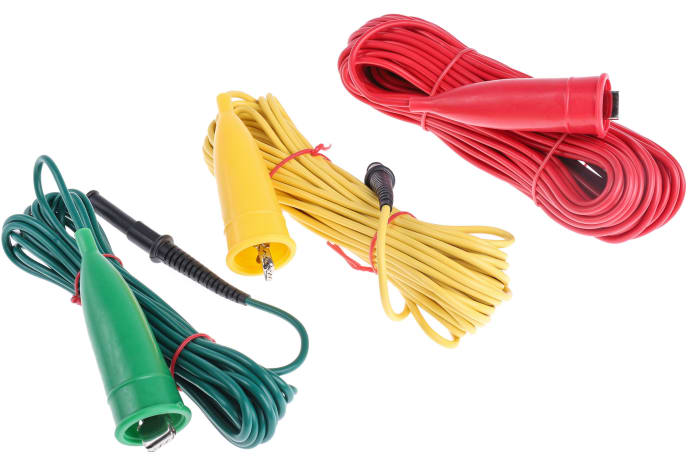
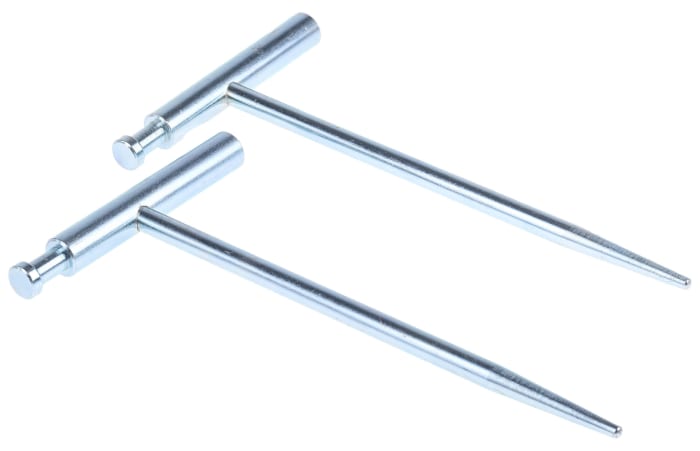
Say goodbye to unpleasant shocks thanks to this earth tester kit from FLUKE. It includes a pair of auxiliary spikes along with three wire test leads to achieve a strong connection. To use the kit, position your spike at the testing point and hook up each lead to your testing device. Next, run the wire out to your test point, clipping the end directly onto the spike. Regular testing is essential to ensure electrical currents have a free path to earth, which keeps you and your equipment safe.
The kit includes lead lengths of 5m, 10m and 20m, so you can choose a single length or use the three-wire connection method to suit your installation.
Easy earth resistance testing is made possible with Fluke's kit, featuring a 3 wire connection method and auxiliary earth spikes. For testing with the Fluke 1653 and 1653B, this kit comes with a portable case keeping the contents compact and neat.
A ground or earth is a conducting connection, usually between an electrical circuit and the earth. Earth grounding is a connection from a circuit conductor, usually the neutral, to a ground electrode or plate placed in the earth. Equipment grounding ensures that operating equipment or a circuit is grounded properly. This prevents differences in voltage potential from a possible flash-over from things such as lightning strikes by ensuring the current finds a safe path to the earth.
A ground resistance tester is able to take resistance measurements using several test methods, selective testing, stake-less testing, 2-pole testing and 3-4-pole testing. They are able to test the resistance between the earth plate or earth electrode and surrounding ground. In pole testing probes are entered in to the ground and a reading is taken at each location. Readings are then plotted against the distances, the point where the resistance drops is the approximate resistance of the grounding. This is called the fall of potential method and is highly reliable.
Stock information temporarily unavailable.
€ 262.00
€ 262.00 1 Kit (Exc. Vat)
€ 328.81
€ 328.81 1 Kit (inc. VAT)
1
€ 262.00
€ 262.00 1 Kit (Exc. Vat)
€ 328.81
€ 328.81 1 Kit (inc. VAT)
Stock information temporarily unavailable.
1
Technical Documents
Specifications
Brand
FlukeProduct Type
Earth Tester Kit
Measurement Type
Earth Resistance
Includes
Carrying Case, Probe, Test Lead
Standards/Approvals
No
Model Number
ES165X
Country of Origin
Thailand
Product Details
Say goodbye to unpleasant shocks thanks to this earth tester kit from FLUKE. It includes a pair of auxiliary spikes along with three wire test leads to achieve a strong connection. To use the kit, position your spike at the testing point and hook up each lead to your testing device. Next, run the wire out to your test point, clipping the end directly onto the spike. Regular testing is essential to ensure electrical currents have a free path to earth, which keeps you and your equipment safe.
The kit includes lead lengths of 5m, 10m and 20m, so you can choose a single length or use the three-wire connection method to suit your installation.
Easy earth resistance testing is made possible with Fluke's kit, featuring a 3 wire connection method and auxiliary earth spikes. For testing with the Fluke 1653 and 1653B, this kit comes with a portable case keeping the contents compact and neat.
A ground or earth is a conducting connection, usually between an electrical circuit and the earth. Earth grounding is a connection from a circuit conductor, usually the neutral, to a ground electrode or plate placed in the earth. Equipment grounding ensures that operating equipment or a circuit is grounded properly. This prevents differences in voltage potential from a possible flash-over from things such as lightning strikes by ensuring the current finds a safe path to the earth.
A ground resistance tester is able to take resistance measurements using several test methods, selective testing, stake-less testing, 2-pole testing and 3-4-pole testing. They are able to test the resistance between the earth plate or earth electrode and surrounding ground. In pole testing probes are entered in to the ground and a reading is taken at each location. Readings are then plotted against the distances, the point where the resistance drops is the approximate resistance of the grounding. This is called the fall of potential method and is highly reliable.